
Heute bestellt, morgen abgeholt! Nutzen Sie unseren Click & Collect-Service hier im Webshop oder geben Sie Ihre Bestellung unkompliziert über WhatsApp mit einem Klick auf den Button auf.

Details
DRM: Readium LCP DRM
Weitere Details
Owen Hopkins
1. Auflage 2023
12.12.2023
English
136 S., 28.76 MB
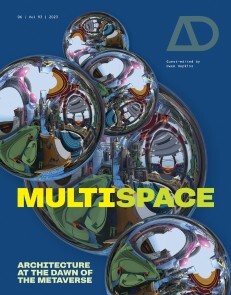
Multispace
eBook - Architecture at the Dawn of the Metaverse, Architectural Design
Beschreibung
Guest-edited by Owen Hopkins
Multispace exists at the intersection of the physical and digital, and in the blurring of their previously clear dividing lines. Multispace is not a single space, but a hybrid space where, in effect, we occupy multiple spaces simultaneously. We enter it on a Zoom call, when we are in our officeand in a meeting with 20 people; when we are cycling down a country lane whilst racing against thousands of others who also use the Strava app; when we are watching a TV show while live tweeting; or, perhaps most literally, when wandering around the local park looking for creatures that only appear on a smartphone screen.
A fundamental question of thisADis why the phenomena that multispace describes are of concern to architects. The answer is that multispace points to a situation that is at root an architectural one. Offering both a collective and highly personalised experience, static and dynamically customisable, and above all at the same time publicand private, multispace lies at the centre of a set of tensions, concerns and preoccupations at the core of our conception of architecture as theory and practice. It is the messy space between, with rough and uneven edges that are constantly shifting.
Contributors: Aleksandra Belitskaja, Alice Bucknell, Jesse Damiani, Wendy Fok, Andrew Kovacs, Lara Lesmes and Fredrik Hellberg, Micaela Mantegna, Holly Nielsen, Giacomo Pala, Paula Strunden, Lucia Tahan, and Francesca Torello and Joshua Bard.
Featured architects and artists: iheartblob, Ibiye Campis, Office Kovacs, Space Popular and Liam Young.
Über Owen Hopkins
Inhalt
About the Guest-Editor 5
Owen Hopkins
Introduction Architects in Multispace 6
Owen Hopkins
The Portal Galleries: Researching Portals in Fiction from the 19th Century to the Present 14
Lara Lesmes and Fredrik Hellberg
The Home as an Infinite Screen 22
Lucia Tahan
Hidden Infrastructures: From Spy-Hubs to Hollow Buildings that Conceal the New Digital 30
Wendy W Fok
Architecture in Postreality: Emerging Approaches to Space in Hybrid Realities 38
Jesse Damiani
Touching, Licking, Tasting: Performing Multisensory Spatial Perception Through Extended-Reality Models 48
Paula Strunden
Multipurpose Domesticity: Labour, Leisure and Kitchen Tables 56
Holly Nielsen
Conjunctions: Or, Space as Oxymoron 64
Giacomo Pala
Celebrating the Glitch: The Multispatial Work of Ibiye Camp 72
Owen Hopkins
Architecture is Interface: Latent Virtuality from Antiquity to Zoom 78
Joshua Bard and Francesca Torello
Very Big Art: Follies, the Public and Multispace 86
Andrew Kovacs
Ways of Worlding: Building Alternative Futures in Multispace 94
Alice Bucknell
The Anti-Metaverse: Multispace and the Intersections of Reality 104
Micaela Mantegna and Marcelo Rinesi
All At Once From Zoom Fatigue to Immersive Digital Experiences: Why Architecture Must Adapt 112
Sasha Belitskaja
Shifting Contexts: Liam Young's Prototypes of Architectural Futures 122
Owen Hopkins
From Another Perspective The Haçienda Must Be Built 128
Neil Spiller
Contributors 134
E-Book Informationen
Alle hier erworbenen E-Books können Sie in Ihrem Kundenkonto in die kostenlose PocketBook Cloud laden. Dadurch haben Sie den Vorteil, dass Sie von Ihrem PocketBook E-Reader, Ihrem Smartphone, Tablet und PC jederzeit auf Ihre gekauften und bereits vorhandenen E-Books Zugriff haben.
Um die PocketBook Cloud zu aktivieren, loggen Sie sich bitte in Ihrem Kundenkonto ein und gehen dort in den Bereich „E-Books“. Setzen Sie hier einen Haken bei „Neue E-Book-Käufe automatisch zu meiner Cloud hinzufügen.“. Dadurch wird ein PocketBook Cloud Konto für Sie angelegt. Die Zugangsdaten sind dabei dieselben wie die Ihres Kundenkontos in diesem Webshop.
Weitere Informationen zur PocketBook Cloud finden Sie unter www.meinpocketbook.de.
Allgemeine E-Book-Informationen
E-Books in diesem Webshop können in den Dateiformaten EPUB und PDF vorliegen und können ggf. mit einem Kopierschutz versehen sein. Sie finden die entsprechenden Informationen in der Detailansicht des jeweiligen Titels.
E-Books ohne Kopierschutz oder mit einem digitalen Wasserzeichen können Sie problemlos auf Ihr Gerät übertragen. Sie müssen lediglich die Kompatibilität mit Ihrem Gerät prüfen.
Um E-Books, die mit Adobe DRM geschützt sind, auf Ihr Lesegerät zu übertragen, benötigen Sie zusätzlich eine Adobe ID und die kostenlose Software Adobe® Digital Editions, wo Sie Ihre Adobe ID hinterlegen müssen. Beim Herunterladen eines mit Adobe DRM geschützten E-Books erhalten Sie zunächst eine .acsm-Datei, die Sie in Adobe® Digital Editions öffnen müssen. Durch diesen Prozess wird das E-Book mit Ihrer Adobe-ID verknüpft und in Adobe® Digital Editions geöffnet.
Bei E-Books die mit Readium LCP geschützt sind erscheint bei dem ersten Öffnen auf ihrem Reader ein Hinweisfenster mit der Aufforderung ein Passwort einzugeben. Gleichzeitig öffnet sich ein Infofeld in dem das Passwort steht. Tragen Sie dieses Passwort in das Eingabefeld ein und bestätigen Sie die Eingabe. Danach öffnet sich das E-Book automatisch. Um E-Books die mit Readium LCP geschützt sind auf einem Tablet/Laptop/Smartphone lesen zu können, benötigen Sie ein Programm, das in der Lage ist, mit diesem Kopierschutz umzugehen. Das ist z.B. der Thorium Reader (Windows, Mac, Linux) oder die PocketBook App (iOS, Android). Fügen Sie das heruntergeladene E-Book in das Programm ein. Bei dem ersten Öffnen erscheint ein Hinweisfenster mit der Aufforderung ein Passwort einzugeben. Gleichzeitig öffnet sich ein Infofeld in dem das Passwort steht. Tragen Sie dieses Passwort in das Eingabefeld ein und bestätigen Sie die Eingabe. Danach öffnet sich das E-Book automatisch.